LED Backlight Technology: A 7-Step Beginner’s Guide to Brighter, Smarter Screens
Published: 30 Sep 2025
LED Backlight Technology: A Step-by-Step Guide
Many people think the picture on their TV or monitor is created by a single sheet of light. But it’s more like a talented team working behind the scenes. Think of it like a modern art projector versus an old-fashioned one. The old technology would use one big, bulky lamp to light up the entire slide, which often led to dim corners and uneven colors. LED Backlight Technology, on the other hand, is like having thousands of tiny, individual lights working together. This allows for incredible precision, letting parts of the screen be pitch black while others shine with brilliant color, creating the stunning image quality we enjoy today. That’s its unique power.
Let’s be honest, most of us just turn on our screens without a second thought. But what happens behind that glass is pure magic. This guide is for anyone who’s ever been curious about how their TV, computer monitor, or smartphone produces such vivid images. We’re going to walk through the world of LED Backlight Technology together. I’ll explain everything in plain English, without the confusing technical jargon. By the end, you’ll not only understand how it works but also be able to make smarter choices when you’re buying your next screen. We see this technology every day, so let’s give it the attention it deserves.
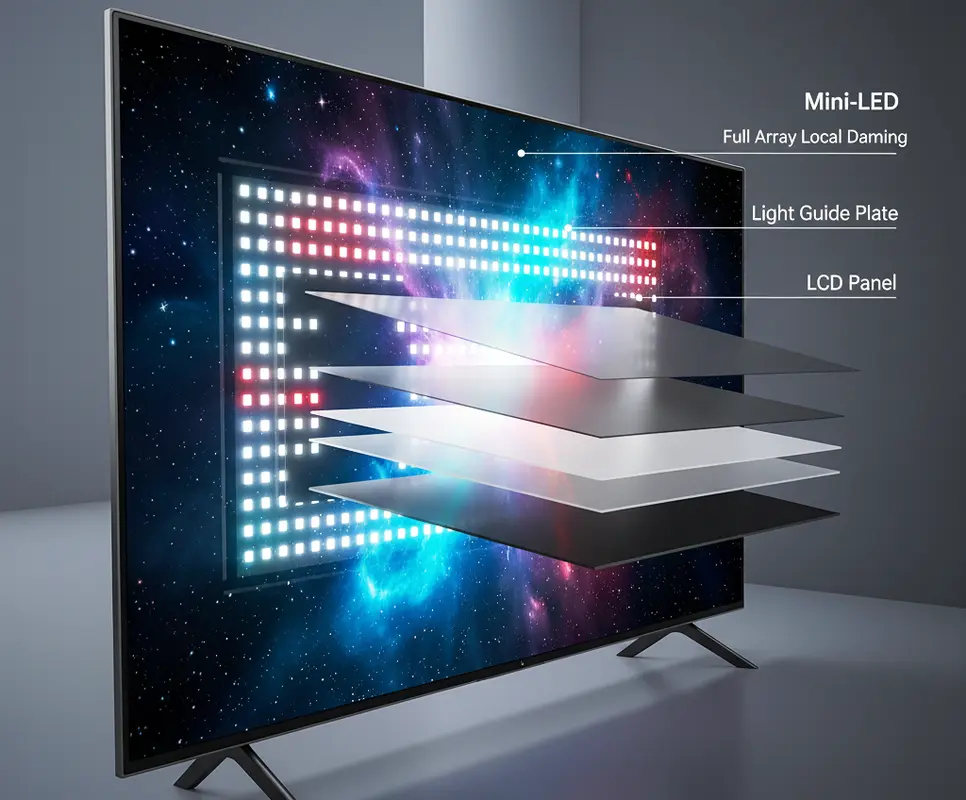
The Core Building Blocks of LED Backlights
Understanding the basic components is the first step to understanding the whole system. It’s like knowing the ingredients before you bake a cake.
- LEDs (Light Emitting Diodes): These are the tiny, powerful lights that are the heart of the system. They are energy-efficient, long-lasting, and provide the raw light.
- Light Guide Plate (LGP): This is a clear, acrylic panel that acts like a highway for light. It takes the bright light from the LEDs and spreads it evenly across the entire screen.
- Diffuser Sheets: These layers sit on top of the light guide plate. Their job is to soften the light and eliminate any hot spots, ensuring you see a smooth, uniform glow without any bright lines.
How LED Backlighting Transforms Your Viewing Experience
This is where the magic happens. The components work together to create the image you see.
- The Journey of Light: It all starts when the LED Backlight Technology up. Their light is shot into the edge of the light guide plate. Inside the plate, the light bounces around and is forced to spread out evenly.
- Creating Uniformity: This evenly spread light then hits the diffuser sheets, which act like a soft filter. They blur the individual light points into a single, consistent sheet of light that is perfectly ready to illuminate the pixels on your screen.
- The Final Picture: This uniform white light then passes through the LCD layer, which is a grid of millions of tiny shutters (pixels). These shutters open and close to block or let through light, and a color filter adds the red, green, and blue to create the final picture you see.
A Deep Dive into Different LED Backlight Types
Not all LED backlights are created equal. The placement of the LEDs makes a huge difference in performance and cost.
Edge-LitLED Backlight Technology
This is a very common design, especially in thinner and more affordable TVs and monitors.
- How it Works: The LEDs are placed only along the edges of the screen, typically at the bottom or on all four sides. The light is then channeled inward across the screen using the light guide plate.
- The Main Advantage: The biggest benefit is that it allows manufacturers to create incredibly slim devices. It’s also a cost-effective method, which makes these screens more budget-friendly.
- A Key Limitation: The main challenge with this design is achieving perfect uniformity. You might sometimes see the screen being slightly brighter near the edges where the LEDs are located, especially when watching dark scenes.
- Local Dimming Challenge: Because the lights are only on the edges, it’s very difficult to dim specific areas of the screen independently. This can lead to “blooming,” where light from a bright object bleeds into a dark area nearby.
- Best Use Cases: This technology is perfect for everyday use in environments where you have some ambient light. It’s great for general TV watching, office work, and gaming where absolute black levels are not the top priority.
- Our Suggestion: If you’re looking for a sleek, modern TV for a bright living room that won’t break the bank, an edge-lit model is a solid choice. Just don’t expect the same deep blacks as more advanced types.
Full-Array Local Dimming (FALD) LED Backlight Technology
This is where things get serious about picture quality. FALD is a significant step up from edge-lit designs.
- How it Works: Instead of being on the edges, hundreds or even thousands of LEDs are arranged in a grid directly behind the entire LCD panel. This is a game-changer.
- The Power of Local Dimming: The “local dimming” part is the key feature. The screen can control these LEDs in separate zones. So, if one part of the screen needs to be bright and another part needs to be dark, it can dim or turn off the LEDs in the dark zone completely.
- The Resulting Benefit: This ability to control zones independently leads to a spectacular improvement in contrast ratio. Blacks look truly black, not gray, because the LEDs in those areas are switched off. This makes colors pop and the image look more lifelike.
- Blooming Reduction: While not perfect, FALD does a much better job at reducing the light blooming effect compared to edge-lit systems, as the dimming zones are more precise.
- Consideration on Zones: The quality of a FALD screen heavily depends on the number of dimming zones. More zones mean more precise control and a better picture. High-end models have many zones, while budget FALD TVs have fewer.
- The Trade-Off: The main downside is that these screens tend to be thicker and more expensive than their edge-lit counterparts due to the more complex hardware inside.
- Our Suggestion: If you are a movie enthusiast or a gamer who values deep blacks and high contrast, investing in a TV with a good FALD system is one of the best decisions you can make for your home theater.
Mini-LED Backlight Technology: The Modern Marvel
Mini-LED is the latest evolution of FALD technology, taking its principles to an extreme level.
- What Makes it Special: The difference is in the size of the LEDs. Mini-LEDs are, as the name suggests, significantly smaller than conventional LEDs used in standard FALD setups.
- The Big Advantage: Because the lights are tinier, manufacturers can pack thousands, even tens of thousands, of them into a single screen. This means they can also create thousands of distinct dimming zones.
- Precision Unmatched: With so many zones, the screen’s control over brightness and darkness is incredibly precise. This minimizes blooming to a level that is often barely noticeable and brings black levels closer to what you see on an OLED screen.
- Performance in Bright Rooms: Mini-LED TVs often get very bright, making them an excellent choice for rooms with a lot of sunlight, as they can overcome glare effectively.
- The Bridge Technology: Many experts see Mini-LED as the perfect bridge technology between traditional LCDs and OLEDs, offering superb contrast without the risk of burn-in that some OLEDs can have.
- Availability: While initially found only in high-end models, Mini-LED Backlight Technology is quickly trickling down to more mid-range TVs and monitors, making it more accessible.
- Our Suggestion: If you want the best possible picture quality from an LCD-based screen and are willing to pay a premium for it, a Mini-LED TV is currently the top choice. It’s a fantastic investment for a premium viewing experience.
Why LED Backlights are a Superior Choice
It’s helpful to understand why this technology became the global standard.
- Energy Efficiency: LEDs use far less electricity than the old CCFL (Cold Cathode Fluorescent Lamp) backlights they replaced. This is better for your electricity bill and the environment.
- Slimmer Profiles: The small size of LEDs is the reason we have incredibly thin TVs and monitors that can be mounted flush on a wall. This was impossible with older, bulkier technology.
- Better Color and Brightness: LEDs can produce a wider color gamut and much higher peak brightness levels, which is essential for enjoying HDR (High Dynamic Range) content.
- Longer Lifespan: LEDs are very durable and can last for tens of thousands of hours before their brightness starts to fade, meaning your screen will look great for many years.
Caring for Your LED Backlight Technology Screen
To keep your screen looking its best for years to come, a little care goes a long way.
- Cleaning Correctly: Always use a soft, dry, microfiber cloth. If needed, lightly dampen the cloth with water only. Never spray liquid directly onto the screen, as it can seep in and cause damage.
- Avoiding Static Images: Try to avoid leaving a static image (like a news channel logo or a game’s HUD) on the screen for very long periods. While less prone to it than OLEDs, LCDs can still suffer from temporary image retention.
- Managing Brightness: Using the default or “standard” picture mode is usually best. Setting the brightness to maximum all the time is not necessary for most viewing environments and can reduce the long-term lifespan of the LEDs.
The Future of Screen Illumination
The LED backlight technology continues to evolve. What’s next after Mini-LED?
- MicroLED: This is the next big frontier. Unlike LCD screens that need a backlight, each pixel in a MicroLED screen is its own microscopic, self-emitting LED. This promises the perfect blacks of OLED with even higher brightness and no risk of burn-in. It’s currently very expensive but represents the future.
- Advanced Local Dimming Algorithms: The software that controls the dimming zones is getting smarter every year. Future TVs will be even better at managing contrast and eliminating artifacts like blooming.
Conclusion
We’ve journeyed from the basic parts to the advanced types like Mini-LED, and I hope you now see your screen in a whole new light. Understanding LED backlight technology isn’t just about knowing technical terms; it’s about appreciating the engineering marvel you use daily and making an informed choice for your next purchase. At www.ledscreentechnology.com, we believe that knowledge empowers you to choose the best technology for your needs. If you have more questions, feel free to explore our website for more easy-to-understand guides!
FAQs about LED backlight technology
An LED TV uses a separate backlight unit behind an LCD panel to create light. An OLED TV has pixels that produce their own light individually. This means OLED can turn off pixels completely for perfect blacks, while an LED TV dims zones of its backlight.
While individual LEDs can technically be replaced, it is an extremely complex and delicate process best left to professional technicians. In most cases, if a large section of the backlight fails, it’s more practical to consider replacing the screen or device, especially with modern, thin designs.
Local dimming is a feature where the TV’s backlight is divided into zones that can be dimmed or brightened independently. This improves contrast by making bright areas of a scene brighter and dark areas darker, making the image more realistic.
Generally, yes. More dimming zones allow the TV to control brightness more precisely, leading to better contrast and less unwanted light bleed (blooming) around bright objects. However, the quality of the dimming algorithm is also very important.
This is a common characteristic of edge-lit LED screens. The LEDs are placed on the perimeter, and while the light guide plate tries to spread the light evenly, some unevenness, often called “clouding” or “flashlighting,” can be visible, especially in dark scenes.
Yes, modern LED backlights are safe. Unlike older technologies, they do not emit UV light. However, watching any screen for a long time can cause eye strain. It’s always a good idea to take breaks and use features like a blue light filter in the evening.
LED backlights are designed to last a long time. Most are rated for 30,000 to 100,000 hours of use. This means if you watch TV for 8 hours a day, the backlight should last for over 10 years before you might notice any significant dimming.
The key difference is size. Mini-LEDs are much smaller, allowing thousands more to be placed in the same space. This results in many more dimming zones, which greatly improves the precision of the contrast and black levels compared to a standard Full-Array LED backlight.
A dead pixel is usually an issue with the LCD layer itself, not the backlight. There are some software techniques that can sometimes revive a “stuck” pixel, but a truly dead pixel is a physical defect and cannot be fixed without replacing the entire panel.
Flickering can have several causes. It could be a loose cable connection, an issue with the power supply, an incompatible refresh rate setting, or a problem with the backlight’s power inverter. Check connections and settings first; if it persists, it may need professional repair.





- Be Respectful
- Stay Relevant
- Stay Positive
- True Feedback
- Encourage Discussion
- Avoid Spamming
- No Fake News
- Don't Copy-Paste
- No Personal Attacks
- Be Respectful
- Stay Relevant
- Stay Positive
- True Feedback
- Encourage Discussion
- Avoid Spamming
- No Fake News
- Don't Copy-Paste
- No Personal Attacks
